Showing posts with label jaguar. Show all posts

Sedan Jaguar XJ

Tuesday, August 23, 2011 0 comments
When you're sitting behind the wheel of a new Jaguar XJ, it would appear that no rainy day could affect your mood. Well, except for those 6,475 U.S.-spec units manufactured between July 28, 2009 and November 3, 2010, on which the front wiper arms weren't sufficiently torqued during assembly. Consequently, Jaguar has issued a recall for the affected cars, according to a NHTSA press release.

2012 Jaguar XF

Tuesday, August 9, 2011 0 comments


The British Automaker Jaguar has unveiled the 2012 Jaguar XF at the 2011 New York Auto Show, which the 2012 Jaguar XF receives an impressive restyling in the form of a facelit with more sophisticated appearance and comprehensive upgrading like advanced new technologies and new entry-level engine which makes the 2012 Jaguar XF is the most fuel efficient Jaguar.


The 2012 Jaguar XF exterior features a new front fascia with a revised front wings, hood and grille, which the front wings incorporates new triangular side vents. The headlamps incorporates HID bi-xenon headlamps, which the LED running lights are semi-encircled by Jaguar ‘J-Blade’ signature.


At the rear, the 2012 Jaguar XF exterior also features new full-LED taillamps extend more deeply onto the decklid which separated with gloss black lower edge. While the 2012 Jaguar XFR also features aggressive and assertive styling boast a lower and sleeker profile with a reshaped larger lower front intakes for the 2012 Jaguar XFR 510 HP supercharged engine, that leads onto reshaped fenders and hood which fitted with louvers featuring the “supercharged” script.


The result is a sporty, more cohesive look and even more aggressive, although the 2012 Jaguar XF characterizes changes is much more like on the latest Jaguar design that applied to flagship the new Jaguar XJ sedan. Jaguar also will offer the 2012 Jaguar XF in 3 new exterior colours and new alloy wheel in 18″, 19″ and 20″ that provide the finishing touches to the 2012 Jaguar XF


“The XF has rightly been recognized as a quintessential Jaguar sedan. It is purposeful yet elegant, with inherent sporting intent in its design. For the latest version we have been able to evolve and enhance that performance character.” said Ian Callum, Design Director, Jaguar Cars.


In the Euro-spec 2012 Jaguar XF engine is powered by a new 2.2-liter four-cylinder turbodiesel that delivers a total of 190 HP and 332 lb-ft. of torque. The 2012 Jaguar XF engine is mated with an new eight-speed automatic transmission, which the 2012 Jaguar XF can accelerate from 0-100 km/h in 8.5 seconds with hit a top speed of 225 km/h and returns an average fuel economy of up to 43.5 mpg on the European combined cycle with CO2 emissions of 149 g/km, which these engine recently announced as the most efficient powerplant offered by Jaguar.


But, in U.S. the 2012 Jaguar XF engine comes with a 5.0 liter V8 engine that produces 385 HP, while the 2012 Jaguar XFR supercharged version that produces either 470 or 510 HP, which the either engine is mated to a six-speed automatic transmission with sequential shifting manual mode.


Inside, the 2012 Jaguar XF interior features new improved seats and trim, new XJ-inspired color and trim combinations, restyled steering wheel joining revised switchgear, a digital full colour instrument panel, infotainment system with a 7″ touchscreen display, various controls receive a new black finish and an available with three new premium audio systems, such as 1,200-watt/17-speaker tour de force package from British sound gurus Bowers & Wilkins, while in XFR version comes with the black seats with ivory stitching and Carbon fiber replaces the wood


The 2012 Jaguar XF interior also comes with a hard-drive based satellite navigation system that can store up to 10 CDs, a multiple options for portable players with two USB ports and Bluetooth connectivity and Jaguar’s Interactive Voice functionality.


The 2012 Jaguar XF price is estimated around in range $63,000-$85,000, which will go on sale later this summer.


[Source: autoclubmax.com]


It Came From eBay Hell: 1993 Jaguar XJ6 “Airport Limousine”

Friday, July 15, 2011 0 comments

In the glory days of air travel – when you could still smoke and fly without the fear of being groped and fondled by security personnel wearing latex gloves– some passengers were lucky enough to commute from the terminal to their hotel in the back of an airport limousine.
These stretched cars, with their multiple rows of seats and doors, were essentially the primitive precursor to the modern day shuttle bus.

Great variety of fun stuff over at Tamerlane's Thoughts, not all car stuff though, lots of travels

Wednesday, May 18, 2011 0 comments
the above Land Rover advertisement is brilliant, go see the world and get your passport stamped
Who know Sammy had a Delorean?
The source of the above XJ220 Jag's tail lights? the below Rover... huh

Wow, rare Jeep FC 170 and Civil Defense with the old license plates!

these two were photographed at the Sonoma Marin Concours
all this variety is from just the only http://karakullake.blogspot.com/

Jaguar XJ220

Friday, May 13, 2011 0 comments
The Jaguar XJ220 is a mid-engined supercar produced by Jaguar in collaboration with Tom Walkinshaw Racing as Jaguar Sport between 1992 and 1994. It held the record for the highest top speed of a production car (350 km/h, 217 mph) (although it was modified from standard to achieve this), until the arrival of the McLaren F1 in 1994. The XJ220 is unrelated to other XJ models, despite sharing the "XJ" prefix.In the early days of the company, certain Jaguar employees had created an informal group they called "The Saturday Club" (so-named because they would meet after-hours and on weekends to work on unofficial pet-projects). In the 1980s, Jaguar's chief engineer Jim Randle, as part of that group, began work on what he saw as competition for cars like the Ferrari F40 and Porsche 959. He envisioned what was essentially an updated XJ13 - a lightweight two-seater with a powerful mid-mounted V12 engine. Randle expanded on the idea by settling on all wheel drive for increased traction and better handling and an integral safety-cage so the car could be safely raced at extremely high speeds. From the outset, the intention was to create a vehicle capable of exceeding 320 km/h (200 mph).Jaguar executives who saw the concept were sufficiently impressed to formally commit company resources to producing a car for the 1988 British Motor Show. Tom Walkinshaw Racing was engaged to produce a 6.2-litre version of Jaguar's V12 engine with four valves per cylinder, quad camshafts, and a target output of 500 hp (370 kW; 510 PS). The all-wheel drive system was produced by FF Developments, who had experience with such systems going back to the 1960s and the Jensen FF. The styling of the car was done by Keith Helfet and included scissor-style doors similar to those in use by Lamborghini in several of their cars. The name "XJ220" was assigned as a reference to the targeted top speed of 220 mph (350 km/h). The prototype car was significantly heavier at 1,560 kg (3,439 lb) than other Jaguar racers like the XJR-9. But as it was intended to be, first and foremost, a roadcar, it would be more appropriate to compare it with something like the XJS; in spite of being 30-inch (762 mm) longer and 10-inch (254 mm) wider and even with the added weight of the all-wheel drive system, the XJ220 was still 170 kg (375 lb) lighter than the XJS. The car was officially announced in 1989 with a price of £361,000 ($580,000 USD) and prospective buyers were expected to put up a deposit of £50,000 ($80,000 USD) to be put on the waiting list for delivery. Because Jaguar promised to limit initial production to 220 units and that total production would not exceed 350, many of those who put deposits on the cars were speculators who intended to sell the car at an immediate profit.

The production version of the car was first shown to the public in October 1991 after undergoing significant changes. The most obvious of which was a completely different drivetrain and the elimination of the scissor doors. TWR was charged with producing the car and had several goals/rules: the car would be rear wheel drive instead of all wheel drive; would have a turbocharged V6 engine instead of the big V12; and performance goals of over 200 mph (320 km/h), 0 to 60 mph (97 km/h) in 3.8 seconds, and the lightest weight possible. The 6.2-litre V12 had been judged too difficult to get past increasingly strict emission regulations, and there were also reportedly some design problems caused by the size of the power plant. It was replaced with a Tom Walkinshaw-developed 3.5-litre V6 based on the engine used in the Austin Metro 6R4 rally car and fitted with twin Garrett T3 turbochargers, generating 542 bhp (404 kW; 550 PS) of maximum power at 7000 rpm and 476 lb·ft (645 N·m) of torque at 4500 rpm. This engine was the first V6 in Jaguar's history, and was the first to use forced induction. In spite of the smaller displacement and half the number of cylinders, the engine produced more power than the V12 would have. However, potential customers judged the exhaust note to be harsh and the lag from the turbos to be an annoyance. Also missing from the production version of the car was the Ferguson all wheel drive – the production car had only rear driven wheels, through a conventional transaxle – and the ABS. With the promise of four-wheel drive and a 500bhp Jaguar V12 this sounded like a dream come true for enthusiasts and speculators alike. Unfortunately, when production finally began in the early 90s, the boom had gone and Group B (for which the XJ220 was originally conceived) had disappeared. Not only this but Jaguar had made the unpopular decision to drop the 4WD and V12 drivetrain for RWD and turbocharged V6. This led to disgruntled customers, many of whom launched court cases against Jaguar, only to lose, and ultimately unsold 220s.The car entered production in 1992 in a purpose-built factory at Bloxham near Banbury, and the first cars were delivered to customers in July. Original customers included Elton John and the Sultan of Brunei.


Jaguar XJ 220

Many of the initial customers were dissatisfied not only with the modifications to the original specification but the significant increase in delivery price from the original £361,000 to £403,000 ($650,000 USD). Another blow to potential sales was a global recession which took hold between the car's original announcement and its eventual release. This caused many original speculators to not want to buy the car, either because they were no longer able, or because they did not think they could sell it on. Further complicating the issue was Tom Walkinshaw's offer of the faster (by acceleration, not top speed), more expensive and more exclusive XJR-15 which was based on the Le Mans champion XJR-9. Some customers reportedly either sued Jaguar or threatened to sue; in any case, Jaguar gave the customers the option to buy themselves out of the delivery contract. As a result, many of the owners challenged Jaguar in court where the Judge eventually sided with Jaguar. To reduce costs the use of parts from mass production cars had been extensive; for example the rear view mirrors came from the Citroën CX 2 Series. In spite of the drama surrounding its creation, a total of 281 cars were made and by 1997, few of these remained available for sale new at £150,000. Nowadays, it remains a sought-after collectible sports car, fetching £100,000+.The XJ220 is not only the fastest but the widest car Jaguar has ever built at nearly 7 feet in width. A racing version called the XJ220C was also made. The XJ220C, driven by Win Percy won its first race, a round of the BRDC National Sports GT Challenge at Silverstone. Three works XJ220C's were entered in the 1993 Le Mans 24 Hour race, in the newly created Grand Touring Class. Two of the cars retired but one XJ220, driven by John Nielsen, David Brabham and David Coulthard took the checkered flag to take a class win. This, however, was revoked two weeks later when the XJ220C was disqualified for not running catalytic converters on the cars when the road-going XJ220s did. An XJ220 would also be used in the Italian GT Championship in the early 1990s, although this car had no factory support. During the mid-nineties, the Sultan of Brunei and his brother Prince Jefri secretly bought hundreds of sports cars and had them custom appointed by various companies. One of these is a custom Jaguar XJ220 that has been heavily modified by Pininfarina. Modifications included fixed headlights, replacing the pop-up versions originally installed, and a redesigned double-vane rear wing.In 1992 at the Nardò Ring, Martin Brundle drove an XJ220 to 212.3 mph (341.7 km/h). The car's catalytic converters sap the engine of an estimated 60 bhp (45 kW), the catalysts were later disconnected and the rev limiter was increased from 7200 rpm to 7900 rpm in a quest to enable the XJ220 reach a higher top speed. On a later run with the modifications, Brundle took the XJ220 to 217.1 mph (349.4 km/h) (the equivalent to approximately 223 mph (359 km/h) on a straight road).

Jaguar C-X75

Sunday, April 17, 2011 0 comments
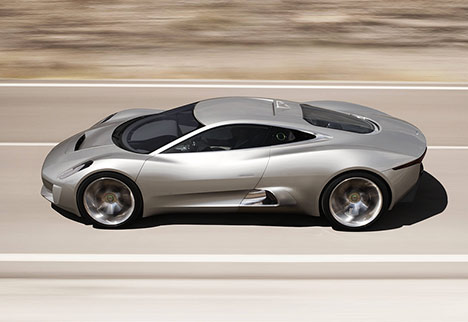
Jaguar C-X75 is a plug-in hybrid, two-seat, concept car from Jaguar which debuted at the 2010 Paris Motor Show. The C-X75 produces 778 horsepower through four electric motors, each of which drives one of the four wheels. The batteries driving these motors are recharged using two diesel-fed micro gas turbines instead of a conventional four-stroke engine. The C-X75 was named in honor of Jaguar’s 75th anniversary, the C stands for concept and the X for experimental. In terms of performance, Jaguar envisions future super cars reaching 330 km/h (205 mph) and accelerating from 0 to 100 km/h (0 to 62 mph) in 3.4 seconds and 80 to 145 km/h (50 to 90 mph) in 2.3 seconds. It is powered by four 145 kW (194 hp) electric motors – one for each wheel - which produce 780 hp (582 kW) and a total torque output of 1,600 N·m (1,180 ft·lbf). Inherent in the drivetrain is the ability to independently vector torque to each wheel across the full speed range. The micro gas turbines developed in a partnership with Bladon Jets generate enough electricity to extend the range of the car to 900 km (559 mi) while producing 28 grams of CO2 per kilometre on the EU test cycle. While running solely on battery power, the C-X75 has an all-electric range of 110 km (68 mi). Among other advantages, the micro turbines used in the C-X75 can be run on a range of fuels including diesel, biofuels, compressed natural gas and liquid petroleum gas. Jaguar also focused on the aerodynamics in order to improve performance. For example, the carbon-fibre rear diffuser, an element in guiding airflow under the car and creating downforce, includes an active aerofoil and is lowered automatically as speed increases. Moreover, the C-X75 features an extruded and bonded, aerospace-inspired, aluminium chassis, saving on weight and improving sustainability and performance.


Jaguar C-X75 Electric-Turbine Concept

Jaguar C-X75 With Turbo Speed

Jaguar C-X75 Interior Concept

Jaguar C-X75 Speedometer

Jaguar C-X75 Top View

Jaguar C-X75 Exotic Interior

Jaguar C-X75 On The Road

Elegant Jaguar C-X75

Jaguar Sport Cars

Monday, April 4, 2011 0 comments
Various Of Jaguar Sport Cars

Elegant Jaguar Sport Car

American Jaguar Sport Car

Red Jaguar Sport Cars

Sporty Jaguar Sport Cars

Luxury Jaguar Sport Cars

Silver Jaguar Sport Cars

2012 Jaguar Sport Cars XKR-S

Tuesday, March 15, 2011 0 comments
2012 Jaguar Sport Cars XKR-S
MAHWAH, N.J., February 22, 2011 – Jaguar will launch the new Jaguar XKR-S at the Geneva Motor Show on March 1, 2011. 2012 Jaguar Sport Cars XKR-S is the most extreme expression yet of Jaguar's passion for building beautiful, fast cars.  With a higher output supercharged V8 engine, revised suspension, and a new aerodynamically-driven design, the Jaguar XKR-S expresses the company's long held duality of purpose: GT luxury with incredible performance.
The 2012 Jaguar Sport Cars XKR-S get preety look with Metallic Smurf example looks nothing if not more imposing, thanks largely to the additional vents feeding the supercharged V8. Jaguar notes that this is the most powerful and fastest production sports car it’s ever offered.
2012 Jaguar Sport Cars XKR-S
A revised fuelling map means the direct-injection powerplant now produces 550PS and 680Nm of torque. Extensive recalibration has ensured that power delivery and performance are seamless, contributing to a 0-60mph time of 4.2 seconds, and a Vmax bumped out to 186 mph. The Performance active exhaust encourages and rewards the enthusiastic driver with dramatic, motorsport-inspired aural feedback.
2012 Jaguar Sport Cars XKR-S
"The XKR-S is a bold and exciting new model for Jaguar," said Adrian Hallmark, Jaguar's new Global Brand Director. "We expect to attract both loyal and new Jaguar driving enthusiasts who still want the comfort, opulence and class only a Jaguar can offer, combined with inspirational performance."
The 2012 Jaguar Sport Cars XKR-S produces 550 hp with 502 lb/ft of torque, offers a top speed of 186mph (300km/h), and can accelerate from 0-60mph in 4.2 seconds. Full details, images and video of the 2012 Jaguar Sport Cars XKR-S will be released at the Geneva Motor Show press day on March 1, 2011.
The Jaguar XKR-S also required aerodynamic modifications to achieve its 300kph top speed in the unruffled manner expected of a Jaguar and has been designed solely with an eye for purity of line and singularity of purpose. As the XKR-S approaches its top speed, there is a requirement to channel air cleanly over, around and under the car in order to maintain stability and ensure balanced downforce front and rear. An overall reduction in lift of 26 per cent has been achieved.
The performance of the 2012 Jaguar Sport Cars XKR-S is reflected in both its interior and exterior styling, which feature exclusive new paint colours that reflect Jaguar's racing heritage. As with competition Jaguars of the past, the exterior of the 2012 Jaguar Sport Cars XKR-S adheres to the principle of form following function. In addition to the styling changes and in order for it to achieve 300kph, the XKR-S was the subject of extensive Computational Fluid Dynamics development work. The resulting changes reduced front and rear lift by more than a quarter and optimised lateral aerodynamic stability.
2012 Jaguar Sport Cars XKR-S
The performance intent of the 2012 Jaguar Sport Cars XKR-S is clear from the moment the driver enters the cabin thanks to new cosseting Performance seats with prominent shoulder wings for close support during hard cornering. The seats feature 16-way adjustment, memory and heating functions while a new three-spoke steering wheel provides the perfect interface between car and driver.
2012 Jaguar Sport Cars XKR-S

Jaguar XKR Convertible look

Sunday, February 20, 2011 0 comments
In increase to its monstrous strength evaluating, the AJ-V8 Gen III 5.0-liter motor transports a whopping 461 pound-feet of torque. The sprint from zero to 60 mph takes actually 4.6 seconds.

There's not a considerable measure of space for back travelers, but the driver and his or her traveler delight in a lavish terrific touring encounter with enough capacity to give most wears autos a run for their cash.
Jaguar XKR Convertible

Jaguar XKR Convertible

Jaguar XKR Convertible

Jaguar XKR Convertible

Jaguar XKR Convertible

Jaguar XKR Convertible

Jaguar XKR Convertible

Jaguar XKR Convertible

Jaguar XKR Convertible

Jaguar XKR Convertible

2009 Jaguar XKR Convertible.


The XKR Convertible owes its good looking looks to an interesting configuration go at taken by Jaguar's group. In place of outlining the Coupe first and foremost, the plan group started by penning the Convertible. This system guaranteed the drop-beat doesn't basically look love a car with its top slashed off.

Prefer its roadster partner, the XKR Convertible has interesting styling prompts for example a more onrushing front sash, atmosphere admissions on the hood, aluminum-completion grilles, more pleats on the hood, and quad fumes pipes. Clients can picked among 19-and 20-creep wheels for the XKR.